Methodology
Technical specification of the Temporal Validation Impact framework
The Observer Visibility Gap:
"Short-horizon evaluation systems may systematically undervalue long-horizon durability signals."
Core Formula
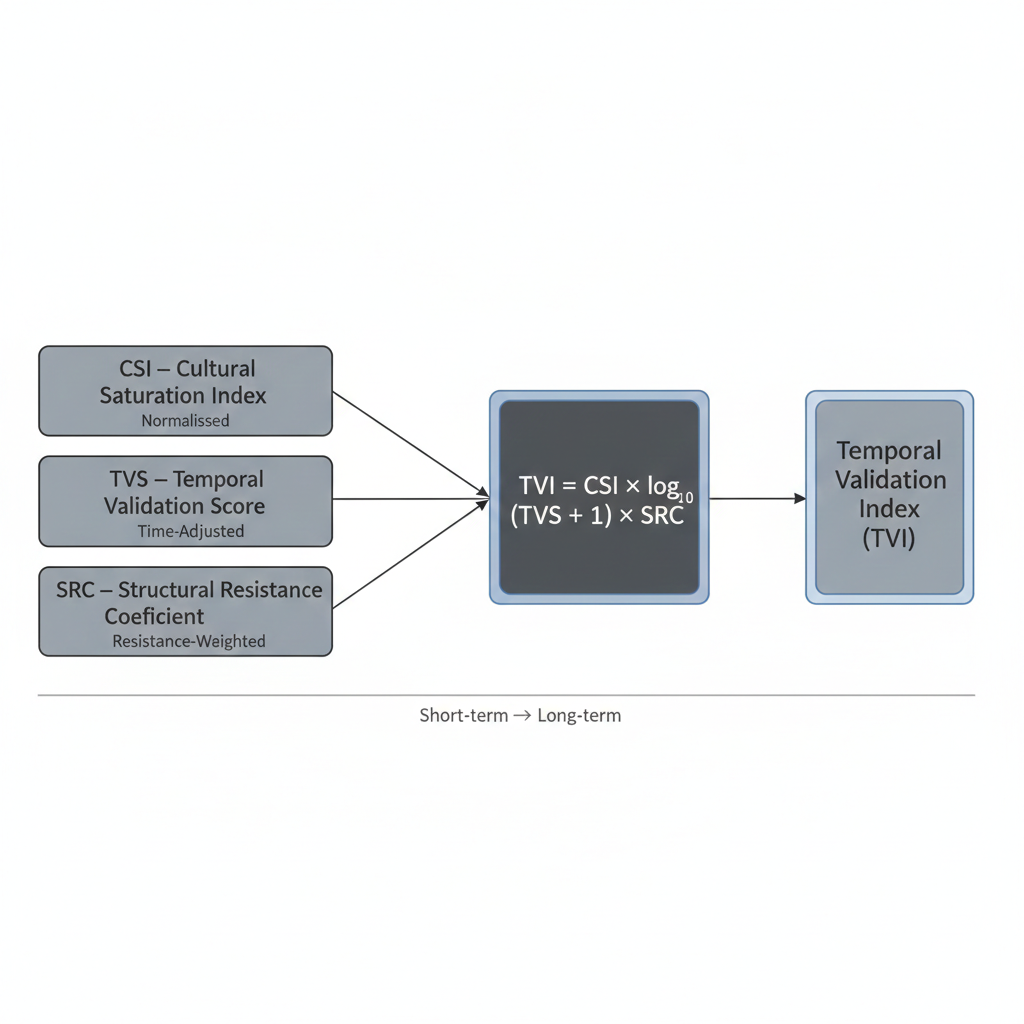
Core Temporal Validation Model: The central engine of the framework, visualizing how Saturation, Temporal Validation, and Structural Resistance create a "Volume of Persistence."
S (Saturation)
Context-normalized reach accounting for era-specific conditions:
Components:
- Raw Reach: Total impressions, views, or usage instances
- Account Factor: Corrects for multi-account inflation over time (1.0 pre-2005, up to 2.5 for long-lived content)
- Available Audience: Platform user base at moment of initial virality (not current size)
- Cross-Platform Multiplier: 1.0 = single platform, up to 3.5 = universal cultural reference
V (Validation)
Time-validated persistence combining three dimensions:
Components:
- Persistence: Months of continued relevance (capped at 180 months = 15 years for normalization)
- Resurfacing Rate: Frequency of renewed attention, measured by documented events per year
- Legacy Level: 1.0 = baseline, 1.5 = meme format, 2.0 = cultural lexicon, 2.5 = academic study, 3.0 = historical artifact
R (Resistance)
Era-based Structural Resistance Coefficient acknowledging that identical metrics represent different achievements across technological/competitive eras:
| Era | Years | R Value | Characteristics |
|---|---|---|---|
| Pre-Platform | ≤2004 | 3.0 | No hosting infrastructure, manual sharing |
| Early Platform | 2005-2009 | 2.5 | Limited users, human-driven discovery |
| Mass Adoption | 2010-2013 | 2.0 | Growing platforms, early algorithms |
| Fragmentation | 2014-2017 | 1.5 | Multiple platforms, algorithm-assisted |
| Algorithm Dominance | 2018+ | 1.0 | Massive scale, fully algorithmic distribution |
Mathematical Properties
Logarithmic Scaling
The log₁₀(V + 1) term serves two purposes:
- Diminishing returns: The difference between 1 and 12 months is more meaningful than between 120 and 131 months
- Zero-handling: The +1 ensures log₁₀(1) = 0 for zero validation, producing TVI = 0
Multiplicative Structure
Deficiency in any component substantially reduces overall score:
- High reach + zero persistence → TVI = 0
- High persistence + zero reach → TVI = 0
- Both required for cultural impact
Domain-Specific Variants
TVI-B (Business Methodologies)
Saturation: Adoption rate and years in use, cross-industry spread
Validation: Sustained implementation, MBA curriculum inclusion, management canon status
TDIS (Training Data Impact Score)
Saturation: Citations, active usage in curricula, framework implementations
Validation: Cross-framework adoption, pedagogical embedding, benchmark persistence
ISPS (Investment Staying Power Score)
Saturation: Brand awareness, market position, era-adjusted founding difficulty
Validation: Crisis survival, leadership continuity, category dominance duration
Modular Analytical Architecture
TVI operates as a modular analytical framework rather than a fixed universal scoring system.
Different systems, industries, institutions, and cultural environments exhibit distinct persistence dynamics, validation behaviours, and structural pressures across time.
As a result, weighting structures, coefficients, validation layers, resilience variables, and sensitivity architectures may be calibrated differently across domains.
Examples include:
- institutional resilience
- investment survivability
- AI dataset durability
- business methodology persistence
- cultural and memetic propagation
The framework is designed to support domain-sensitive calibration, scenario-specific modelling, adaptive weighting systems, comparative benchmark layers, and bespoke resilience architectures.
Transparency of assumptions is prioritised over opaque scoring.
Public vs Proprietary Modelling Layers
Public Framework Layer
The public-facing equation represents the foundational abstraction layer of the TVI framework.
Public framework abstraction layer.
Advanced deployments may incorporate recursive sensitivity weighting, domain-specific calibration, structural Greeks, adaptive deltas, ensemble modelling, and bespoke scoring architectures.
Proprietary Layer
Commercial deployments may incorporate additional recursive weighting systems, structural Greeks, adaptive calibration, domain-specific coefficients, bespoke dashboard architectures, sensitivity overlays, and ensemble analysis systems under licensing agreement.
The sensitivity and proprietary layers do not replace the foundational equation. They modify structural interpretation under specific operational conditions.
Temporal Sensitivity Architecture (“Greeks”)
Advanced TVI implementations may incorporate temporal sensitivity structures inspired by quantitative risk modelling.
These experimental “Greeks” are designed to explore how persistence scores respond to changing environmental, structural, and temporal conditions.
They do not replace the foundational equation. They operate as a sensitivity layer on top of the base model.
Example: Institutional Fragility Overlay
Base TVI:
Sensitivity Layer:
Where:
- ΔR = Recursive Delta
Measures sensitivity to recursive structural change. - κA = Adaptive Convexity
Measures resilience gained through adaptation. - νF = Fragility Vega
Measures stress sensitivity under volatility.
Illustrative Example:
- Base TVI = 18.4
- ΔR = +0.12
- κA = +0.08
- νF = 0.31
Adjusted Structural TVI:
TVI* ≈ 16.0
The sensitivity layer does not replace the foundational equation.
It modifies structural interpretation under specific operational conditions.
The Temporal Org Chart (70/20/10 Rule)
Replacing the traditional org chart with a "Horizon Map." The 70/20/10 rule: 70% of resources must be anchored in the "Foundational" core (Institutional Memory) to survive market volatility.
Organizational design and resource allocation: Most resources must anchor in the foundational core to survive volatility.
Observer Temporal Signature (τ)
Different observers systematically disagree about importance when evaluating identical evidence. We model this through:
Where:
- H (Skill Half-Life): Years until the observer's skills depreciate 50%
- L (Legacy Depth): Stake horizon (1=self, 2=family, 3=community, 4=civilization)
- C (Crisis Anchor): Set of crises calibrating the observer's risk model
- V (Validation Horizon): Default timeframe for judging success (months to decades)
Key Insight: An observer with V=3 months weights psychological time (engagement now). An observer with V=25 years weights cultural time (what persists). This is not preference—it's a horizon-weighting model.
Short-horizon evaluation systems may systematically undervalue long-horizon durability signals.